
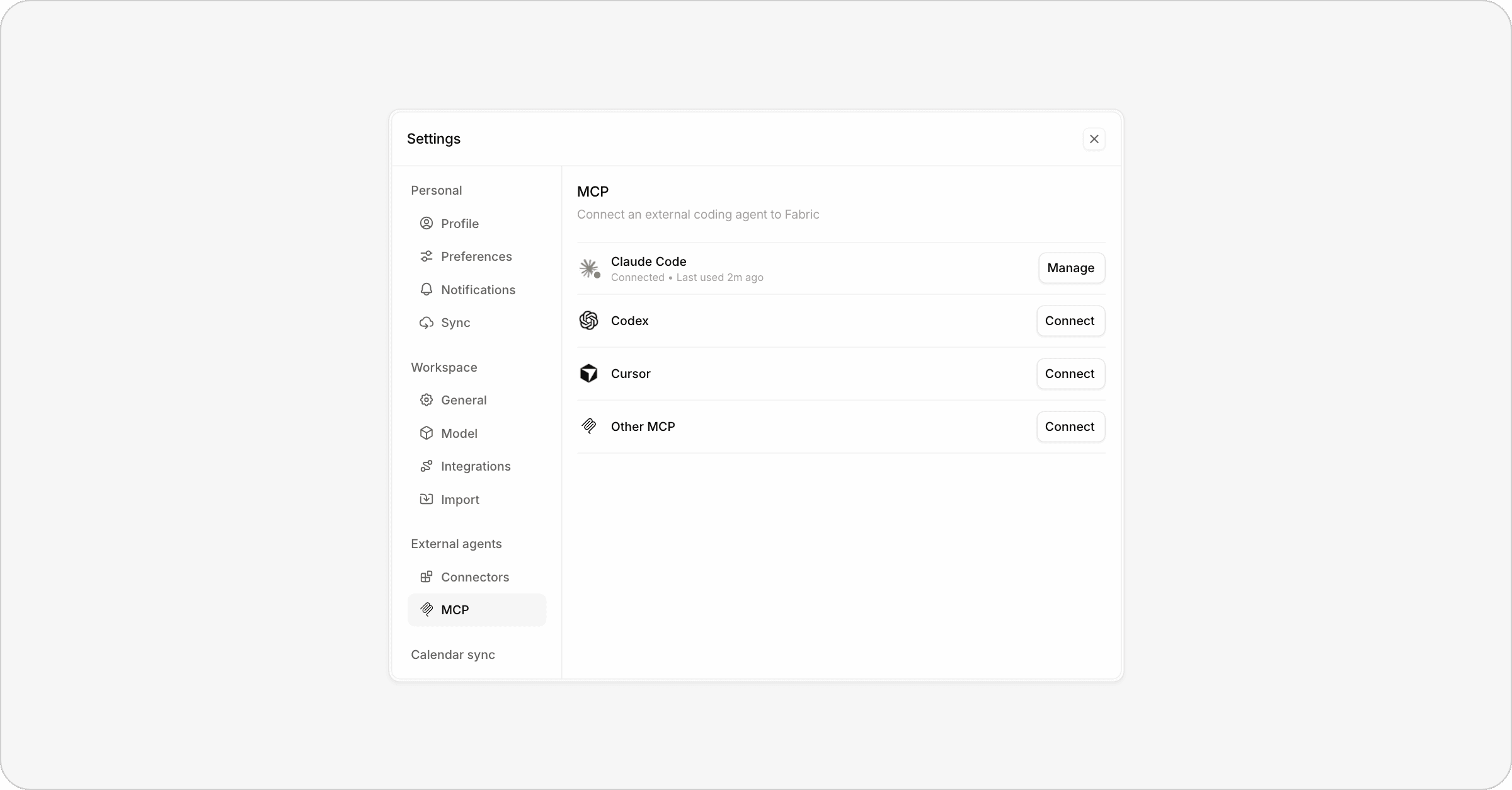
Fabric's built-in MCP server lets the AI agents you already use read your schedule, manage your task list, and plan your day. They can look up tasks, review how your week went, create and reschedule tasks, and block off time on your calendar.
To connect an agent, open Settings → MCP, copy the prompt for your agent of choice and paste it into a new session in that agent. The agent sets itself up and checks that the connection works. Everything stays on your Mac: the agent talks straight to the Fabric app, with no cloud account needed, and you can rename or disconnect an agent at any time.
Fabric has a built-in connector for Claude Code, Codex and Cursor, and an Other MCP option for any other agent that supports local MCP servers.
MCP is for coding agents. To connect a chat agent, such as Claude or ChatGPT, use Settings → Connectors instead. See Connect Claude Connectors & ChatGPT Plugins to Fabric
Before you start
Make sure the Fabric Desktop App is installed. The MCP server runs inside the desktop app.
The agent runs on the same Mac. The connection is local: your agent talks straight to the Fabric app on your computer, without going through Fabric's servers. It works offline and on the Free tier.
Fabric doesn't need to be open. If it's closed when your agent needs it, Fabric starts quietly in the menu bar.
How connecting works
Each agent connects the same way. Fabric gives you a prompt, and your agent sets itself up from it.
In Fabric, open Settings → MCP.
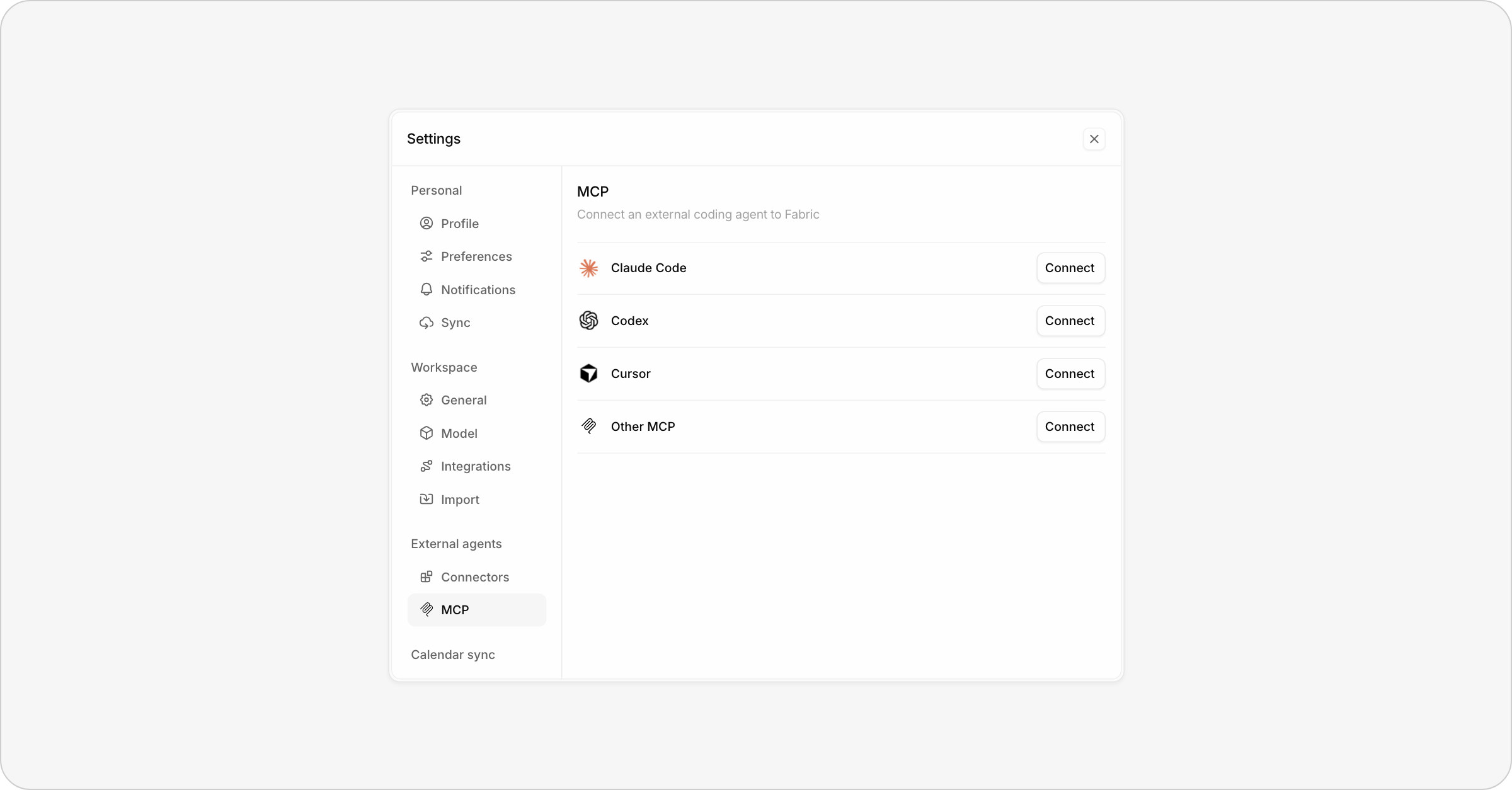
Click Connect next to your agent.
Click Copy prompt.
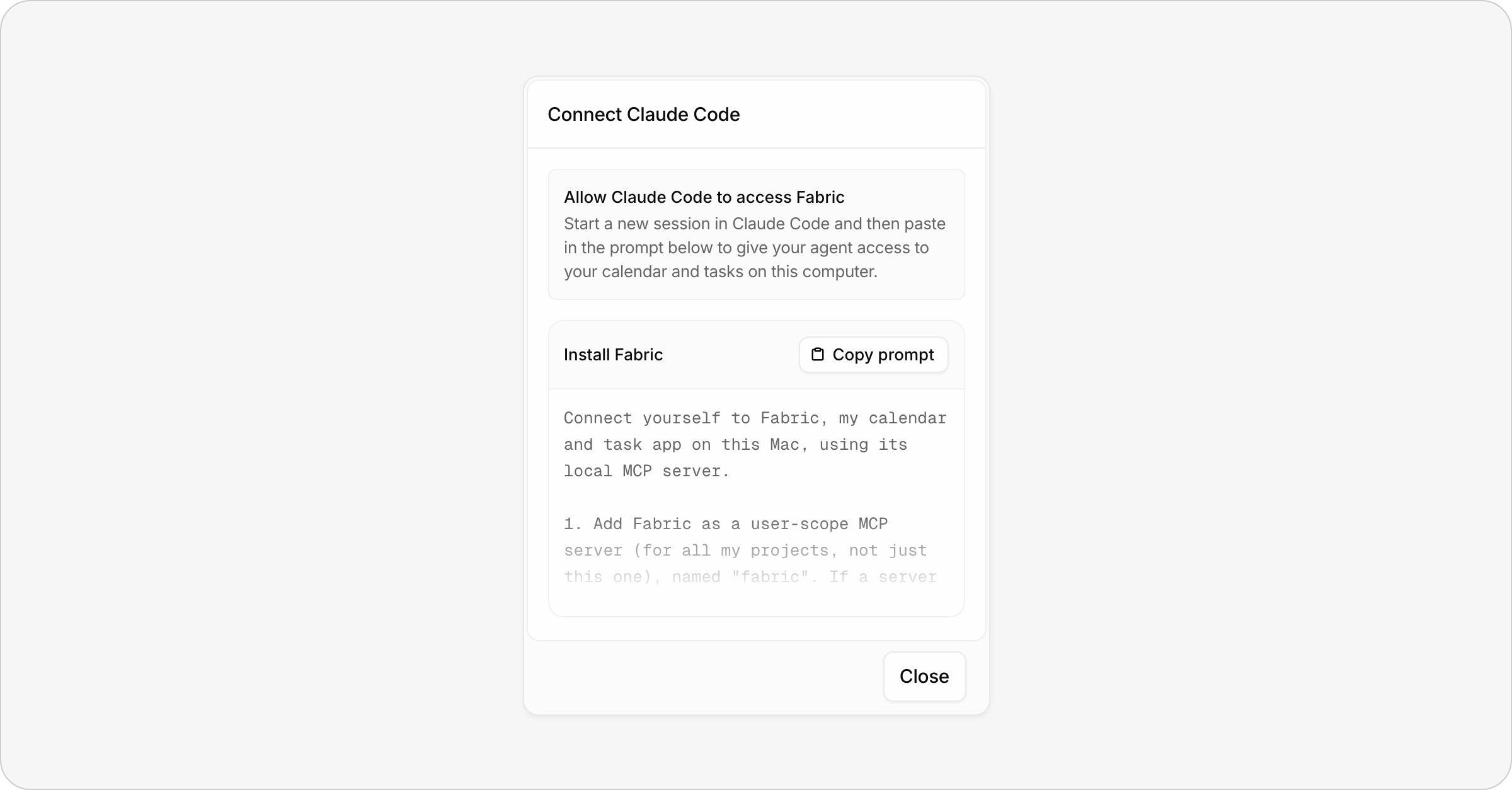
Start a new session in your agent and paste the prompt.
The agent adds Fabric to its MCP settings, runs a quick check, and tells you whether the connection worked.
Start one more new session. Agents load their MCP servers when a session starts, so the session that set Fabric up can't use it yet. The agent will remind you.
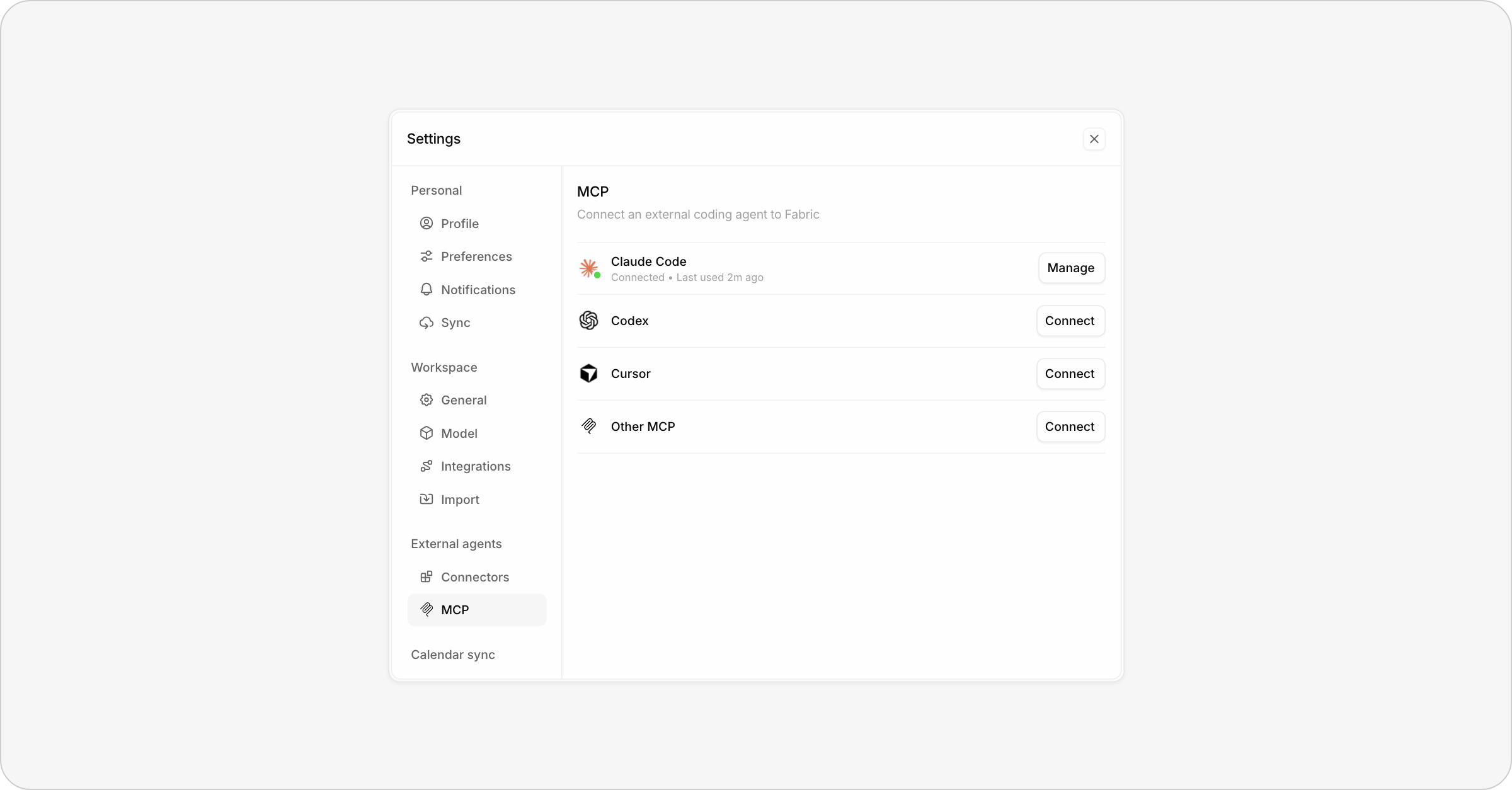
When the check succeeds, the agent's row in Settings → MCP shows Connected, along with when it last used Fabric.
Claude Code
Settings → MCP → Claude Code → Connect, then Copy prompt.
Start a new Claude Code session (in the terminal, the desktop app or your IDE) and paste the prompt.
Claude Code adds Fabric as a user-scope MCP server named
fabric, so it's available in every project, not just the current one. It usesclaude mcp add, or edits~/.claude.jsondirectly if theclaudecommand isn't available.Once it reports success, start a new Claude Code session.
To check that it's working, run /mcp in Claude Code. fabric should be listed as connected.
Codex
Settings → MCP → Codex → Connect, then Copy prompt.
Start a new Codex session and paste the prompt.
Once it reports success, start a new Codex session.
Cursor
Settings → MCP → Cursor → Connect, then Copy prompt.
Open a new Cursor chat in Agent mode and paste the prompt.
Once it reports success, open a new chat.
If Fabric's tools don't appear in the new chat, go to Cursor Settings → MCP and make sure fabric is turned on, or reload the Cursor window.
Other MCP clients
You can connect any agent that supports local (stdio) MCP servers. That includes Gemini CLI, Windsurf, Claude Desktop and many others.
Settings → MCP → Other MCP → Connect, then Copy prompt.
Start a new session in your agent and paste the prompt.
Start a new session (or reload the agent's MCP servers) and Fabric's tools will be available.
Fabric shows the agent under the name it reports for itself, such as "Windsurf". If it doesn't report one, Fabric shows "External Agent".
What your agent can do
Connected agents can do the same things with your schedule that Fabric's own agents can.
Read
Your context: the current time, your time zone and your name.
Your schedule: what's planned for any window of time, including each occurrence of a repeating task and its status. Optionally, it can also see your open task list.
How a past period went: what was planned compared with what got worked on, including reschedules, unstarted tasks and unplanned work.
Tasks: search across all your workflows and My Schedule, and open any task to see its details, calendar blocks, subtasks and comments.
Projects: your list of projects.
Plan
Create tasks: undated, due on a day, at a set time, all-day, split across several blocks, or repeating, with a priority and project.
Reschedule tasks: change when a task happens, its priority, or which project it's in.
Work with calendar blocks: add blocks to a task, or move, resize and remove upcoming blocks.
Block off personal time: lunch, the gym, a school pickup.
Add events: appointments, dinners, flights.
What agents can't do
Mark tasks done or change a task's status
Delete tasks
Edit a task's title or description
Change time segments that have already started
Anything an agent creates is labelled with the agent's display name, so you can always tell what came from your agent and what you added yourself.
Manage or disconnect an agent
In Settings → MCP, click Manage next to a connected agent.
Agent display name: the name Fabric uses for the agent and for anything it creates. Change it and click Update.
Disconnect: the agent loses access to Fabric right away, including in sessions that are already open. To connect it again, click Connect and paste a new prompt.
Disconnecting doesn't remove the fabric entry from the agent's own settings. The entry just stops working. You can ask the agent to remove it, or leave it for when you reconnect.
Troubleshooting
The agent says it's connected, but it can't use Fabric. Start a new session in the agent. The session that ran the setup prompt can't load the new tools.
My agent doesn't appear in Settings → MCP. It shows up after the agent's connection check succeeds. Ask the agent what the check printed. If you copied a prompt but never used it, it expires after 7 days; click Connect to get a new one.
The check fails. Make sure Fabric is installed in your Applications folder. If you disconnected the agent, its old prompt no longer works. Click Connect for a new one.